Why the Algarve’s fishing towns still feel real
The first time we pulled into a harbor car park in the Algarve, we hesitated—half-expecting a staged “fishing village” set with souvenir stalls. Instead, the tell was practical: working boats tied up close, hoses running, crates stacked, and people moving with purpose. It feels real when you’re clearly a guest in someone else’s workday, not the reason the place exists.
These towns still function because fishing isn’t an “activity” layered on top of tourism—it’s infrastructure. But that also means the experience isn’t always convenient: mornings can be brutally early, the good moments are short (a landing, a quick sale), and you’ll sometimes arrive to nothing happening because the sea, the schedule, or the weather decided differently.
The key shift is accepting a little friction. Choose a couple of ports to visit slowly rather than chasing a checklist, and plan around the working rhythm, not your lunch reservation. If you want authenticity, you trade some comfort—tight parking near quays, salty air, and the feeling that you should keep moving and stay out of the way.
Where to go: ports, villages, and working beaches
We kept coming back to the same question over breakfast: do we want the biggest “working” signal, or the easiest morning? For the former, Olhão is hard to beat—proper port energy, utilitarian waterfront, and a town that feels like it’s doing things besides entertaining you. The catch is that it’s not a gentle introduction: parking near the water can be annoying, and if you arrive after the early pulse, it can read as “just a nice promenade” until you know where to look.
If you want something simpler logistically, Portimão gives you scale with slightly more room to breathe, but it comes with a more developed, built-up feel around the edges—useful when you’re balancing comfort and curiosity, less satisfying if you’re chasing small-town texture. Lagos is an easy add if you’re already nearby, yet the marina zone can tilt polished fast; it works better as a quick harbor walk before the day-trippers thicken, not as your main “fishing-life” stop.
For quieter, slower places, we liked pairing a village like Ferragudo (pretty, compact, easier to fit into a late morning) with a working beach like Alvor, where boats and sand coexist. Just don’t bank on constant action there; it’s more “caught glimpses of work” than guaranteed theater, and wind or surf can make it feel paused.
What to do: auctions, markets, and boat rides
On our first “auction morning,” we underestimated how fast the useful part happens. By the time we’d circled for parking and grabbed coffee, the quay had already shifted from noisy purpose to rinsing down and waiting. If you’re trying to catch landings or an actual sale, treat it like a sunrise activity: arrive early, expect a lot of standing around, and accept that weather can cancel the whole thing without drama. It works best if you plan a backup nearby (a market hall or a harbor walk) so an unproductive morning still feels intentional.
Markets are the more reliable bet, but they come with their own friction. In places like Olhão, the fish counters look “authentic” even when the aisles are packed with visitors, and that crowding changes how long you’ll want to linger—great for a quick, focused loop, less great if you’re hoping to chat or photograph without being in someone’s way. Go with a short shopping mission (one or two things to try later) rather than treating it as a museum, and you’ll feel less rushed by the pace of locals who are there to get in and out.
For boat rides, the decision is whether you want scenery or working context. Tourist cruises are easy to book and low-effort, but they can flatten everything into “coastline content.” If you can find a small operator tied to the day’s conditions (tides, wind, where the boats actually are), it feels closer to the real water logic—just be honest about comfort: choppy crossings and strong sun turn a two-hour trip into a test of patience if you’re not prepared.
How to be respectful in active communities
The moment we realized we were “in the way” was embarrassingly small: we stopped at the end of a ramp to watch a boat come in, and within seconds a forklift needed that exact line. In active harbors, the respectful move is often just spatial awareness—stand to the side, keep pathways clear, and don’t treat ropes, nets, or crates like props. It sounds obvious, but in towns where the working edge sits right next to the promenade, it’s easy to drift from observing into obstructing without noticing.
Photos are the other quiet pressure point. A quick wide shot of the scene usually lands fine; pointed lenses at individuals doing their job can feel intrusive, especially when people are tired and moving fast. When it’s busy (Olhão in particular), we defaulted to “no faces, no close-ups” unless we’d made eye contact and got a nod—because the alternative is you getting your perfect image at the cost of someone else’s comfort.
Finally, match your timing to the town’s tolerance. If you arrive at peak activity, keep your visit short and purposeful; lingering turns you into friction. Save your slower wandering, questions, and café time for after the rinse-down moment, when the harbor’s rhythm loosens and you’re not competing with work that can’t wait.
What to eat and how to order locally
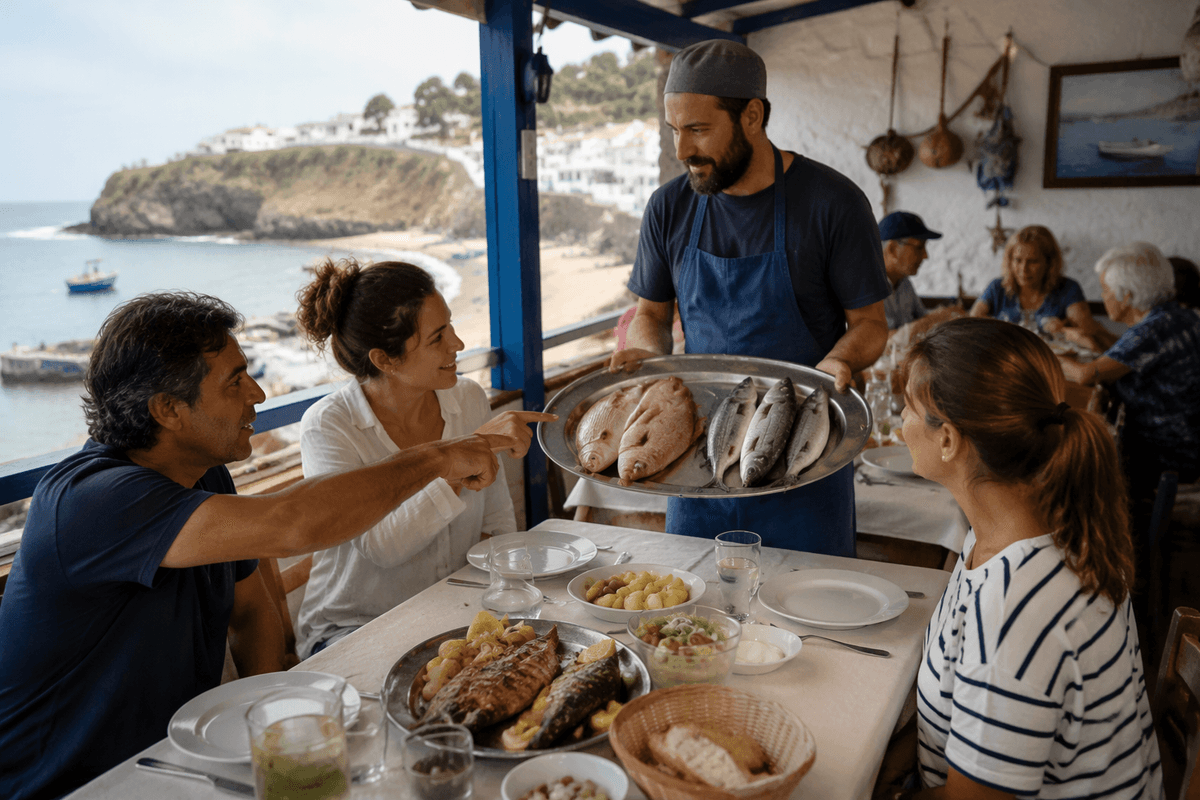
The first menu that made us hesitate wasn’t fancy—it was just long, handwritten, and full of fish names we couldn’t map to English fast enough. In the Algarve, ordering “the grilled fish” can work, but you’ll eat better (and waste less time second-guessing) if you lean into whatever is clearly moving that day. When a place has a chalkboard with two or three peixe do dia options, that’s usually the kitchen quietly telling you what’s freshest and easiest for them to do well; the more laminated, photo-heavy menus tend to be safer for picky eaters but blander, and often priced for the promenade crowd.
How you order matters in small ways. If you’re splitting dishes, say so early—some kitchens assume one fish per person, and it can feel awkward to renegotiate once it’s already being cleaned. We had the best luck asking, simply, “O que recomenda hoje?” (what do you recommend today?) and then choosing one thing we recognized plus one thing we didn’t. If you’re unsure about bones, ask whether it’s better grelhado (grilled) or caldeirada (fish stew), because “easy to eat” and “best expression of the fish” aren’t always the same.
Two practical constraints: lunch hours can be tight, especially if you’ve burned time parking near the waterfront, and the best-looking seafood spots often fill before the service rhythm settles. If you want a calmer meal, eat a little later than locals or go slightly away from the harbor edge—less view, more attention to what’s on the plate.
Leaving with perspective, not souvenirs
On our last morning, we almost squeezed in “one more harbor” and then didn’t—partly because we’d learned that forcing a final checklist stop usually buys you stress (parking, circling, watching the clock) instead of any deeper sense of place. The moments that stuck weren’t the most photogenic ones; they were the functional in-betweens you only notice when you’re not rushing: a quick exchange at a counter, a deck getting rinsed, the town shifting from work to lunch.
If you leave with anything, let it be a small recalibration: these waterfronts aren’t open-air museums, and your time is better spent being briefly, carefully present than collecting proof you were there. The practical cue we kept coming back to was simple—when the working rhythm tightens, step back; when it loosens, that’s when you can linger without turning someone’s day into an obstacle.