You’ve signed plans, but financing is still foggy
The plans are signed, the builder has a start window, and suddenly the “loan” stops feeling like a single decision. The lender asks for a contract price, but allowances are still placeholders. The builder wants a deposit this week, yet the appraisal can’t fully “see” the finished house. Even the timeline is a guess: permitting, weather, and a subcontractor delay can turn a six‑month build into nine, and that changes what the monthly payment needs to be.
At this point, the fog usually isn’t about whether you can qualify today. It’s whether you can stay liquid through an uneven spend schedule, tolerate rate movement while the home is unfinished, and absorb a change order without blowing up the deal. That’s the pressure test before picking a structure.
The pre-approval question that changes everything
The first call with a lender often feels reassuring until one question lands: is that pre-approval for the finished home, or only for the way the project gets funded during construction? On paper, both can look like “yes, you’re approved.” In practice, they behave differently the moment the builder asks for a larger deposit, the county stretches permits by six weeks, or the framing invoice hits earlier than expected. A generic pre-approval letter doesn’t tell you whether the lender is comfortable advancing money against a partially completed asset.
So the decision starts to clarify around what the lender is actually underwriting today. If it’s a construction loan, they’re sizing risk around draws, inspections, and your ability to cover interest-only payments while still paying rent. If it’s a traditional mortgage expectation, the approval may assume a clean, finished appraisal and a single closing date—no messy mid-build cash needs. The constraint is timing: the wrong “pre-approval” can force a late pivot, and late pivots are expensive.
Draws versus one check: cash flow reality
Once the lender is underwriting the construction phase, the money stops behaving like a normal “one check at closing” mortgage. With a draw-based construction loan, the builder’s invoices trigger lender inspections and a release schedule, and that schedule rarely matches how trades actually want to be paid. If the painter needs a deposit Friday but the draw won’t clear until next week, the project doesn’t pause politely; it either strains the builder relationship or pushes you to bridge the gap with cash.
The cash-flow math also gets less forgiving because you’re usually paying interest on what’s been drawn while still paying rent or an existing mortgage. Early months can look cheap, then spike as framing, mechanicals, and drywall stack up, right when the project is least flexible. A single-close or “one-time close” structure can simplify paperwork, but it doesn’t eliminate the uneven spending; it just shifts the friction into reserves requirements, contingency expectations, and how quickly the lender will reimburse. The practical constraint is liquidity: if you can’t float a draw delay or a change order without touching emergency funds, the “cheaper” structure becomes the riskier one.
Rates move while your house is unfinished
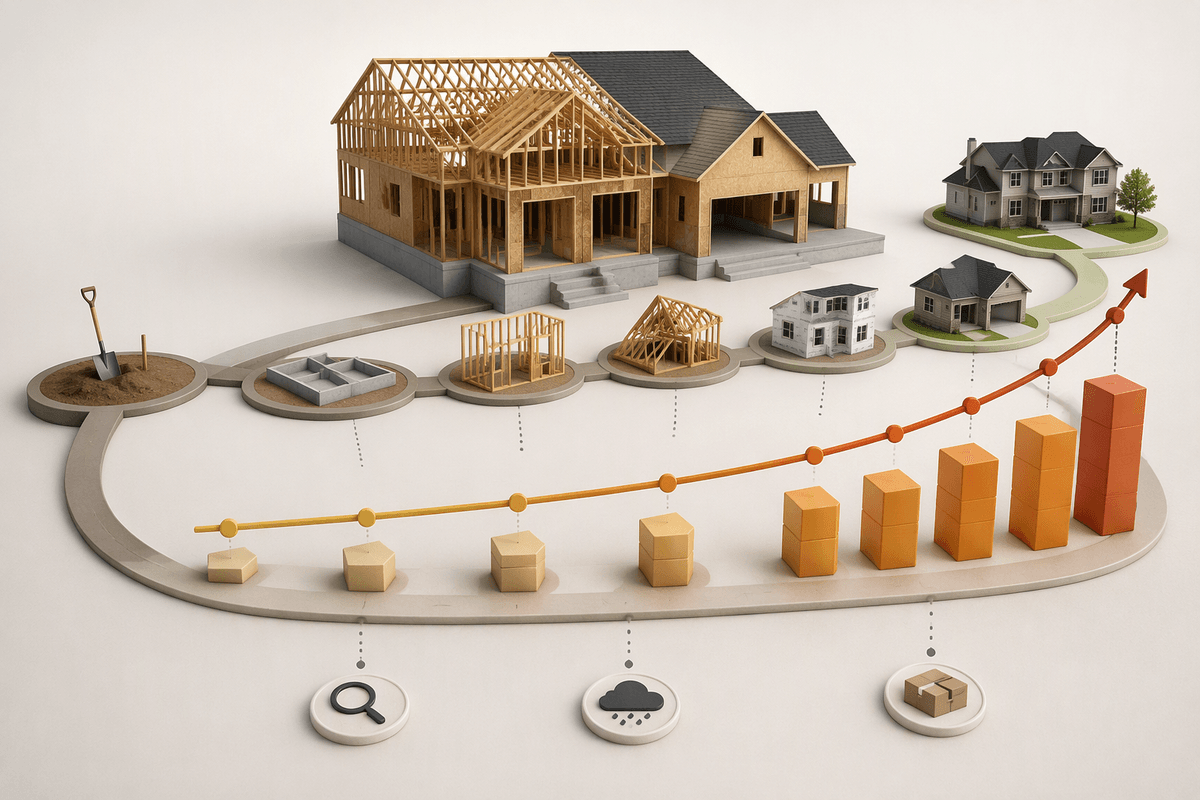
Somewhere around the midpoint of the build, rate talk stops being abstract. You’ve already paid for a few draws, the schedule has drifted a little, and now the lender’s “we can lock later” starts to sound like a bet. If you’re on a construction loan with a floating rate, every uptick shows up as a higher interest-only payment while you’re still carrying rent or your current mortgage. If you’re counting on converting to a permanent loan at completion, the risk shifts: the final payment you modeled six months ago may not exist anymore at today’s pricing.
The constraint is timing, and it’s not fully in your control. Lock options can help, but they often come with rules (how long the lock lasts, extension fees, when it can be exercised) and you don’t get to choose when inspections fail, weather stalls work, or a backordered item pushes the certificate of occupancy. The practical way to stress-test it is to run the budget at a meaningfully higher rate than you expect and ask one uncomfortable question: if rates are worse at completion, do you have the cash flow to finish the project and still qualify for the end loan without cutting corners?
When costs rise, who covers the gap?
Cost overruns don’t arrive as one dramatic bill; they show up as small change orders that quietly break the underwriting box. The construction loan is typically capped by a loan-to-cost or loan-to-value limit based on the original budget and appraisal. If lumber spikes, excavation runs long, or you upgrade finishes midstream, the lender usually doesn’t just “add it on” without re-underwriting—and the appraised value may not move in step with your spend. The constraint is immediate: the draw schedule can keep going, but only up to the approved line.
When that cap gets hit, the gap is almost always yours to cover in cash, and it has to be paid on the builder’s timing, not the lender’s. Some builders will pause work until the change order is funded; some lenders will require a larger contingency reserve up front; and in a one-time close setup, the friction can surface as a required principal reduction or reserve increase before conversion. The practical check is blunt: decide now how much overage you can fund without draining emergency reserves, because that number becomes the real ceiling—not the plans.
The endgame: convert smoothly or requalify painfully

Near the finish line, the financing structure stops being theory and turns into a pass/fail moment. With a true construction-to-permanent setup, the clean version is boring: the home gets its certificate of occupancy, the lender orders the final inspection, and the loan rolls into the permanent phase with minimal new scrutiny. The constraint is procedural timing—if the final paperwork lags while the builder expects the last payment, you still need enough liquidity to keep everything moving.
The painful version is a second qualification that behaves like a brand-new mortgage application. Income, credit, and debts get rechecked, and the numbers are judged against the final rate and payment—not the one you modeled months ago. If you changed jobs, took on a car loan, or your self-employment income looks different, the “conversion” can turn into a scramble for a co-signer, a bigger down payment, or a cheaper rate option you didn’t want. The real risk isn’t embarrassment; it’s being complete and still not financeable on the terms you expected.
A practical tie-breaker and lender-builder questions
When the two options still feel close, the tie-breaker is usually a liquidity test, not a rate quote. If you can cover two or three months of “double housing,” float a delayed draw, and still keep a real emergency fund intact, a draw-based structure becomes tolerable. If that buffer is thin, the “simpler” path is the one with fewer mid-build surprises: fewer re-underwrites, clearer lock terms, and less dependence on perfect timing between inspections and invoices.
Before you commit, press for specifics: What are the exact draw stages, inspection turnaround times, and who pays if an inspection gets kicked back? Can the builder accept partial payments or only lump sums? What reserves are required, what overruns trigger re-underwriting, and what happens if the completion date slips past the lock window? The goal is to find the failure point while it’s still cheap to change your mind.